Masaryk Institute and Archives of the CAS
The Masaryk Institute and Archives of the CAS (MIA) is a public research institution and also a specialised archive, one of the workplaces of the Section of Historical Sciences within the Field of Humanities of the Czech Academy of Sciences. The Institute consists of seven departments, including four scientific research departments and two archival departments.
The scientific research departments of the MIA focus on three main areas of historical research. The first is research on the life and work of T. G. Masaryk, especially with regard to his importance for democratic Czech statehood and his humanitarian legacy, as well as broader research on Czech and Central European history between 1848–1948. The second research area is the history of the Czech Academy of Sciences, its predecessors and the history of science and scientists in the Czech lands and in the wider Central European area. The third area is codicological research, which focuses mainly on the inventory and study of manuscript bohemica from the medieval and early modern periods in the Czech Republic and abroad.
The archival departments of the MIA collect and process the records of the Academy of Sciences, the archival fonds of older scientific institutions and the personal fonds of scientists working in the territory of our country. The Masaryk Institute and Archives of the CAS is also responsible for pre-archival care and shredding supervision within the Czech Academy of Sciences. From its fonds, it provides information to the institutions and departments of the Czech Academy of Sciences and state administration bodies and makes archival fonds and collections available to the research public. The archival part of the MIA also manages the personal archival fonds of T. G. Masaryk, Edvard Beneš, and their associates and family members. The research activities of the MIA archive section are focused on the history of scientific institutions, the life and work of scientific personalities and their community, especially in the Czech environment, the life and work of T. G. Masaryk and E. Beneš, and in particular the access to sources related to their activities.
The Department of Administration and Public Services comprises sections for the individual agendas (Secretariat of the Director, Technical and Economic Administration, Library, Publishing).
The Masaryk Institute and Archives of the CAS publishes two peer-reviewed journals: Střed. Časopis pro mezioborová studia střední Evropy 19. a 20. století | Centre. Journal for Interdisciplinary Studies of Central Europe in the 19th and 20th Centuries and Studie o rukopisech [Manuscript Studies]. In addition to the journals, the MIA publishes editorial series such as Spisy T. G. Masaryka [Writings of T. G. Masaryk]; Korespondence TGM [TGM Correspondence]; Ego. Paměti, deníky, korespondence [Ego. Memoirs, Diaries, Correspondence] (in cooperation with NLN Publishing House) and České moderní dějiny [Czech Modern History] (in cooperation with Academia Publishing House). The Institute’s staff also publishes the results of their work in prestigious journals and book publishers in the Czech Republic, Europe and overseas.
Masaryk Institute of the CAS
The Masaryk Institute of the CAS was established on 1 April 1995. In its activities it followed the T. G. Masaryk Institute, founded by Tomáš G. Masaryk on 23 July 1932 as a foundation whose task was to manage and supplement the library and archives of TGM, to continue editing and publishing Masaryk’s writings, to enable external study of scientists and to publish or contribute to the publication of the results of their work.
As a material basis, T. G. Masaryk donated his private library and archive, a private museum and valuable papers (worth a total of approximately CSK 10 million) to the Foundation. This basic fund was to be the starting point for the study of the areas in which Masaryk was engaged. The first seat of the Institute was Prague Castle, and in 1938 it moved to its own building in Prague-Bubeneč. During the war it was deposited in Klementinum (State & University Library), as the Institute’s building was taken over by the Gestapo. As part of the post-war reconstruction, the Institute got its building back, but its premises were no longer sufficient, so in 1948 it moved to Kramář’s villa in Prague-Hradčany and then to a building on Národní třída 3. In 1954 the Masaryk Institute was closed down as part of the campaign against Masaryk. On 4 January 1990, President Václav Havel decided, on the basis of a proposal by the Masaryk Society Committee, to reinstate the T. G. Masaryk Institute. In 1995, the Masaryk Institute of the Czech Academy of Sciences was established alongside the foundation, which took over the administration of the archives and library and, as an independent department of the Czech Academy of Sciences, gave space to Masaryk research in a broader context. Since 2006, the Masaryk Institute of the CAS has been part of the Masaryk Institute and Archives of the CAS.
Archives of the CAS
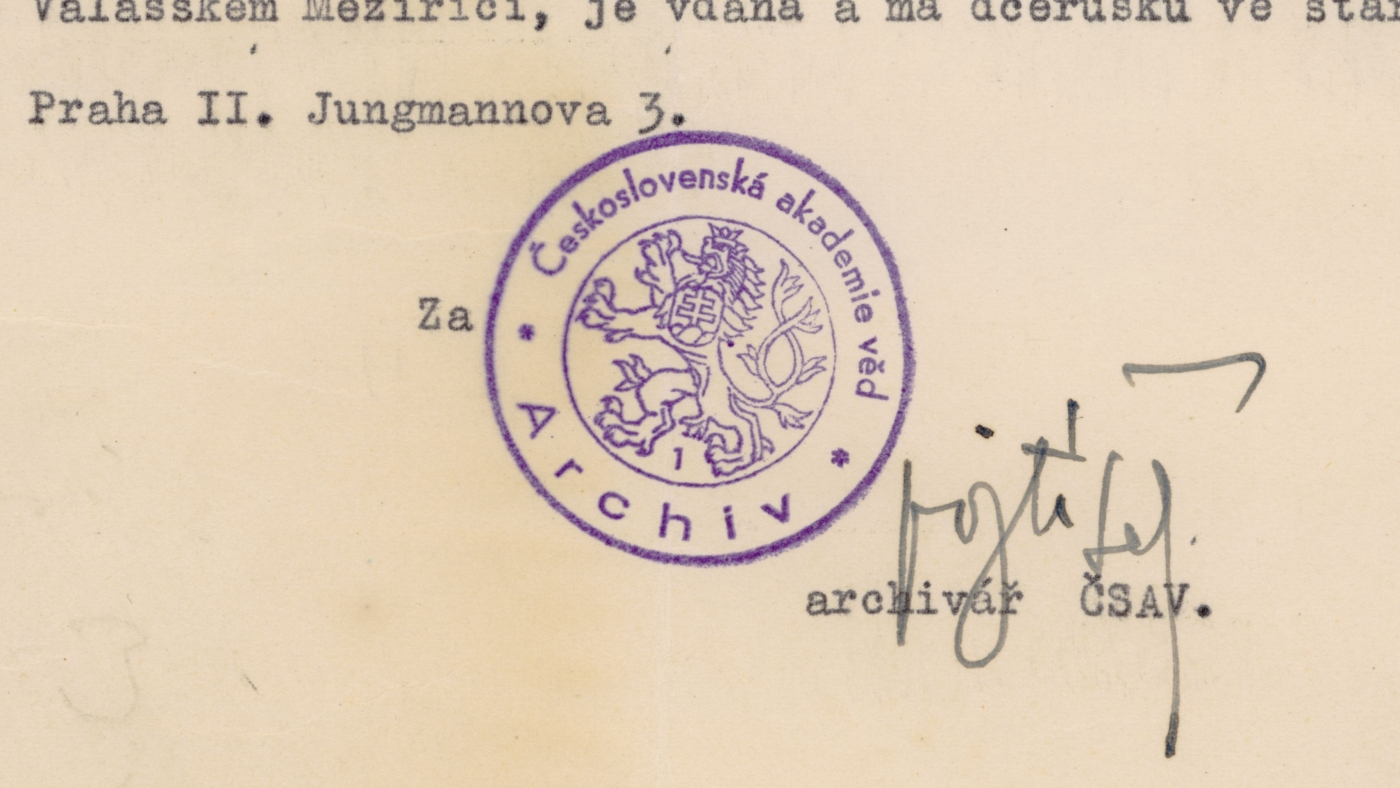
The Archives of the Czechoslovak Academy of Sciences began its activities on 1 January 1953 as a public institution included in the system of Czechoslovak archives. In 1956 it became a special archive, in 1974 an archive of special importance. Its main tasks included and still include the collection and processing of material from the activities of former scientific societies and associations, institutes and organisational units of the CSAS, respectively the CAS, and the remains of our leading scientists. Since 1955, the CSAS Commission for the Cataloguing and Study of Manuscripts has become part of the activities of the archive. On 1 January 1966, the status of the archive within the Czechoslovak Academy of Sciences changed and the workplace was renamed the Central Archive of the CSAS.
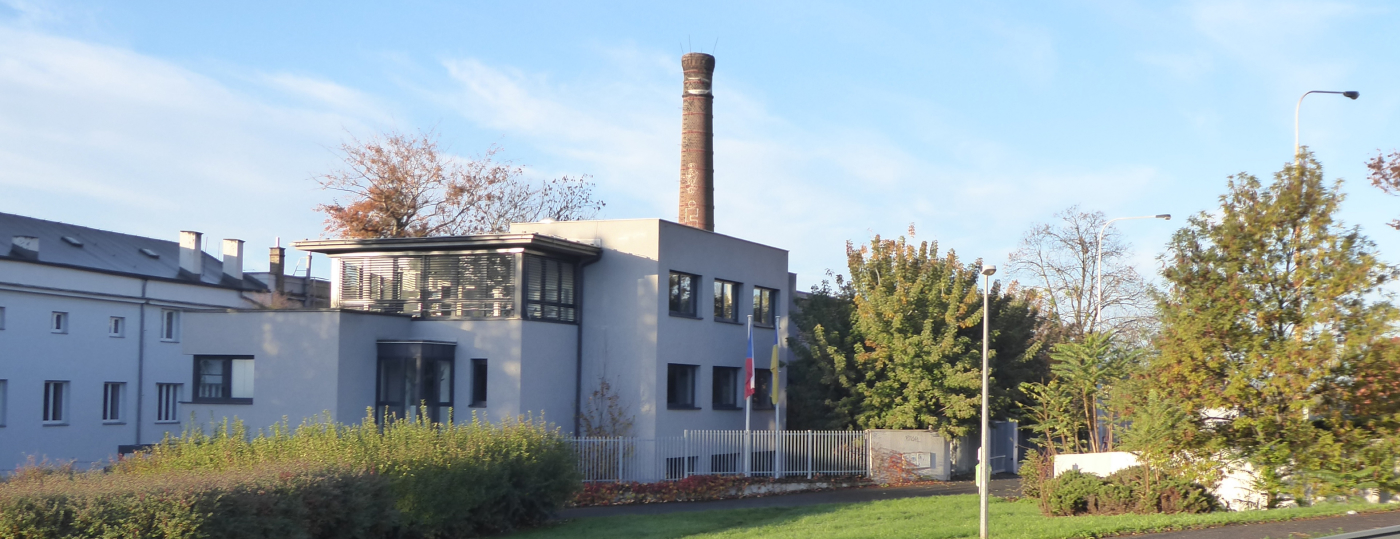
The first fonds managed were the records of the Royal Bohemian Society of Sciences, the Czech Academy of Sciences and Arts, the Masaryk Academy of Labour and the Czechoslovak National Research Council. In addition to receiving fonds, the archive established photographic and art collections and also carried out independent scientific tasks concerning the history of scientific institutions, Bohemian/Czech science, archival science and codicology. The first guide to the fonds, published in 1962, contained 48 fonds and collections. From the late 1960s onwards, specialist working sections were formed – of the predecessors of the CSAS, of personal papers and of the CSAS fonds. Thanks to the increase in the number of staff, pre-archival care was improved, the first official model filing and shredding regulations for the CSAS workplaces were issued in 1972, and the periodical “Archivní zprávy ČSAV” [Archival News of the CSAS] (1970–1985) began to be published. From the mid-1980s, the historical work of the archive became more oriented towards the history of science, and “Práce z dějin Československé akademie věd” [Works in the History of the Czechoslovak Academy of Sciences] were published. Significant changes have taken place in the past twenty years. Since 1991, it has been using premises in Prague–Bohnice and Prague–Libeň, while the offices of the Manuscript Cataloguing and Study Department were located in Husova Street in the Prague Old Town. In connection with the establishment of the Academy of Sciences of the Czech Republic (Czech Academy of Sciences), the department began to use the name of the Archives of the Academy of Sciences of the Czech Republic (from 1 January 1993). In 2005, a new building was opened in Gabčíkova Street in Prague 8, designed specifically for archival purposes. The Archives of the Czech Academy of Sciences have been an accredited specialised archive by law since 2005.
Between 1992 and 1997, the Slavonic Institute operated at the Central Archives of the Czechoslovak Academy of Sciences / Archives of the Czech Academy of Sciences. Initially, between 1992 and 1994, it was a joint workplace of the Czechoslovak Academy of Sciences / Czech Academy of Sciences and Charles University, and then, between 1995 and 1997, it was an autonomous unit of the Archives of the Czech Academy of Sciences.
In 2006, the Masaryk Institute of the CAS was added to the Archives of the CAS and the department was renamed the Masaryk Institute – Archives of the CAS, and since 2008 the Masaryk Institute and Archives of the CAS. In 2007, the MIA CAS became a public research institution and demonstrated that it meets the criteria for accreditation as a specialised archive.